
Showing posts with label Photography Creativity. Show all posts
Showing posts with label Photography Creativity. Show all posts
Monday, October 14, 2013
F Stop EMagazine
If you'd like to see contemporary photography by emerging artists, check out F-Stop, a free on-line photography magazine. Each bi-monthly issue is dedicated to a specific topic, with the current issue focusing on "Cities." Worth a check. http://www.fstopmagazine.com/home.html

Tuesday, October 8, 2013
Snapseed II
When it comes to creativity in photography, there are lots of options, both in camera and post-processing. In a post earlier this summer, I discussed a new app available for iPads (and possibly smartphones, but not desktop or laptop computers). It's called Snapseed and has an amazing array of special effects, most of which are fine-tunable by the photographer.
While India is a blaze of color, the simplicity in me likes the opportunity to boil an image down to its essentials. So, starting with a vibrant color photo, it took only a few adjustments in Snapseed to truly get down to the basics - almost a line drawing. As with any photo of a person, the eyes probably matter the most, and that's obvious here. I did not do selective work (meaning a different degree of adjustment on the eyes versus other elements of the photo), but rather and overall adjustment applied to the whole photo. I love the result. Hopefully you will too!

While India is a blaze of color, the simplicity in me likes the opportunity to boil an image down to its essentials. So, starting with a vibrant color photo, it took only a few adjustments in Snapseed to truly get down to the basics - almost a line drawing. As with any photo of a person, the eyes probably matter the most, and that's obvious here. I did not do selective work (meaning a different degree of adjustment on the eyes versus other elements of the photo), but rather and overall adjustment applied to the whole photo. I love the result. Hopefully you will too!

Thursday, August 29, 2013
Says It All
A picture is worth a 1000 words. Or sometimes it emphasizes one word. A little panning motion shot at 1/13 of a second with the subject - Triumph - in focus. All the elements came together on this one - motion, both of bodies and of the drum stick, background totally blurred and a good depth of field in terms of the drum corps. Taken at the Pacific Northwest Highland Games, August 2013. The Triumph Street Pipe Band of Vancouver BC, one of the world's best pipe bands.


Thursday, August 22, 2013
To Crop or Not to Crop
...that is the question. When in doubt, probably best to stick with the original since that, at least in theory, was meant to be the photograph. Now, there will be times that even in our pre-visualization, we knew that we would need to crop the image due to the limitations of our camera/lens. But usually not. Still, when we get home and see the image on the screen, we realize that there are several potential "final" images (see my August 1, 2013 post for examples).
Sometimes its just not clear what is the "best" image size. Here's my example from the 2010 NW Folklife Festival. The first is the uncropped version (I did change the original from full color to a "toned" photo to emphasize the mood that I felt). This one has a lot of white space, though with the rays of color emanating from the woman, it does add a overall degree of mystery and further emphasizes the woman.


I like both images for very different reasons, for they really become two different concepts, with different emphasis, and there is nothing wrong with that. Just know WHY there are different ways of viewing the original image.
Sometimes its just not clear what is the "best" image size. Here's my example from the 2010 NW Folklife Festival. The first is the uncropped version (I did change the original from full color to a "toned" photo to emphasize the mood that I felt). This one has a lot of white space, though with the rays of color emanating from the woman, it does add a overall degree of mystery and further emphasizes the woman.

The second is the cropped version, focusing in on the two figures, which emphasizes the coming and going of the two dancers. While the woman is still the main subject, due to her facing the camera and the modest color tone of her dress, there is a more equal weight between the two individuals.

I like both images for very different reasons, for they really become two different concepts, with different emphasis, and there is nothing wrong with that. Just know WHY there are different ways of viewing the original image.
Thursday, August 15, 2013
Yes, Photography is Art!

When I completed the book "Another Way of Telling," I immediately picked up the Aperture Masters of Photography book, "Alfred Stieglitz" and read the essay by Dorothy Norman. For Stieglitz, a photograph reflects what "one truly and most sacredly experiences oneself." He fought beginning in the 1880's for the stature of photography as an art form, a means of "expression to be respected in its own right, on the same basis as any other art form."
And speaking in the 1930's yet even more poignant for today's photographer, Alfred said that "Personally, I like my photographs straight, unmanipulated, devoid of all tricks ... But should any one want to go to his own particular photographic hell in his own particular way - manipulated, hybrid or whatever - I say, "Got to it. But go to it for all you are worth, the harder the better, insisting on your right of way without necessarily disregarding all traffic lights. And if you must disregard even those, I say: 'Go ahead full speed!'
Journey On!
Friday, July 5, 2013
A Goal Finally Realized
In March of this year, on the spur-of-the-moment, I joined ten other photographers on a journey to the Hilo area of the Big Island of Hawaii, lea by Doug Beasley. One of my intentions was to create a black-and-white portfolio of images from this journey. But as I've told my own photo students in the digital photo era, always shoot in color; you can always convert to black-and-white later, while the reverse only works if your hand tint! So, I created hundreds of color images during the ten days among the sun (occasionally), rain (pretty much every day), sand (lots of days), and adventures (daily) of the trip. And I was pretty pleased with the results.
But, the original intent of creating black-and-white images was still out there. (BTW, it's interesting to note that half of the participants in the journey did create black-and-white or sepia-toned photographs during the journey; though all of their original digital files were color.) So, I've been working with a half dozen of my favorite Hilo-area photos over the past week to see what works in black-and-white or another technique that I called "faded color." The latter tones down the color saturation (by color channel) and keeps a modicum of the principal color(s) while making the rest of the photo black-and-white.


But, the original intent of creating black-and-white images was still out there. (BTW, it's interesting to note that half of the participants in the journey did create black-and-white or sepia-toned photographs during the journey; though all of their original digital files were color.) So, I've been working with a half dozen of my favorite Hilo-area photos over the past week to see what works in black-and-white or another technique that I called "faded color." The latter tones down the color saturation (by color channel) and keeps a modicum of the principal color(s) while making the rest of the photo black-and-white.

Bamboo with such a touch of the yellow-orange stocks and a very light touch of green leaves.

A morning sunrise over the ever-present clouds from the local beach. It was dramatic enough to survive a full desaturation.

A canopied-roadway where I toned down the brilliant green leaves, and the fallen brown leaves, and then added a bit of blur (actually de-clarified the image in Lightroom) for a more mystical feeling.

More bamboo trees, emphasizing their verticality yet keeping just a touch of the yellow-green leaves.

A grave marker that went from a brilliant color splash of the flower to a pure geometric image when converted to black-and-white.

Finally, my favorite photo from the entire trip, where the small statue had been soft but rough grey-green but now appears from out of the surrounding darkness with the crystal beads still shining.
In case you're curious about the original color photographs, well, here they are. I purposely didn't line them up for comparison sake, since I enjoy both versions. But I also wanted to be true to my original intent - emphasizing graphic images, not necessarily color. And I think I've been able to achieve that - while still creating great color photos as well!


Mahalo!
Sunday, June 30, 2013
Great Photo App
While I primarily process my photographs using Adobe Lightroom which has amazing capabilities, I've come across an iPhone/iPad app that's pretty amazing in and of itself. Its called Snapseed, and it is quick to learn and really easy to use. I took one of my favorite coastal photographs, shot in color with my Nikon D300 and transferred it to my iPad. I then converted it to black and white and used the yellow filter to bring "snap" to the final photograph. And like all good photo software, when I saved it, Snapseed created a new file and didn't override the original color photo. While I'm still really happy with the color version, the B+W version is pretty cool as well. The app is free is available for for both iPad/iPhone and Android users. It was available at one time for PCs/Macs but that version is no longer available. Too bad.


Saturday, June 22, 2013
Panoramas
While I've had my iPhone 5 for a while (early adaptor for a change), I didn't realize that the phone's camera had a panorama feature until more recently. I've been experimenting with the feature and have a few thoughts. First, its pretty cool. Second, you need to pay a lot of attention to the foreground which can take on unexpected prominence. Third, you need to move the iPhone steadily to maximize the usable vertical space (if you don't hold it steady as you sweep the scene, you get black spaces on the top or bottom that then need to be cropped, further reducing the usable vertical image). Fourth, don't overdue it! Panoramas are really designed to capture an overall horizontal scene and are quite effective at it. But those are pretty isolated cases. Fifth, panoramas make good banners for your website (see this sites banner!) or your Facebook timeline. Sixth, experiment!

The beach just north of the Santa Monica pier.
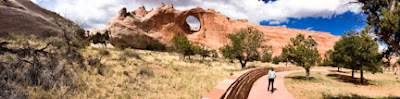
Window Rock, Navajo Reservation, Arizona

The beach just north of the Santa Monica pier.

Window Rock, Navajo Reservation, Arizona
Wednesday, April 17, 2013
Cropping (and Compositional) Techniques
While I don't use or even check my Twitter feed very often, I did come across a posting from Andrew Childress this past week that was intriguing. It discusses the use of Adobe Lightroom in cropping photographs. In doing so, Andrew discusses some fundamental components of composition as well, which can/should be applied in making the original photograph.
Check it out:
http://photo.tutsplus.com/articles/composition-articles/using-lightroom-to-explore-photographic-geometry/
Check it out:
http://photo.tutsplus.com/articles/composition-articles/using-lightroom-to-explore-photographic-geometry/
Monday, February 18, 2013
Dreamstate
As you may have gathering from some past posts, I strive to show emotion via motion from time to time. One of my favorite venues is the Northwest Folklife Festival held at Seattle Center each Memorial Day Weekend. In reviewing photos taken during past festivals, I came across the one below which I hadn't examined for sometime. It was taken with my Nikon D300, with a slow shutter speed (1/10 second) to start showing motion, and then a quick zoom of the lens. The woman is a fairly sharp focus, certainly relative to the rest of the photo. The dancers around her are in motion and the large area of darker tones makes her standout even more. A dreamy image. And a bit of serendipity - you need to be prepared to take lots of such photos, experimenting with shutter speed and zoom techniques, and seeing what happens. And occasionally, you hit it right on.


Monday, February 11, 2013
Simplicity
Keep it simple. I've "preached" this before on this blog as I recall. While a complex photograph with many layers of detail CAN work, I personally find that the simpler the photograph, the more dynamic. Simplicity is not always easy to achieve. Our eyes self edit to a large extent, while the camera lens, as we are all too well aware, sees all. Thus composing for simplicity is the art form.
And as we also understand, photograph is about light. Simple light. Dramatic light. Puerto Vallarta. Sunset. One band of a gradation of sunset red, from the mere hint to the final glow before the sun breaks out of the upper cloud layer. And framed top and bottom by deep bands of black. And enough hint of the shoreline dropping from on high to the waters edge. And just a glimpse of the sun bouncing off the water to give context. Simplicity.

And as we also understand, photograph is about light. Simple light. Dramatic light. Puerto Vallarta. Sunset. One band of a gradation of sunset red, from the mere hint to the final glow before the sun breaks out of the upper cloud layer. And framed top and bottom by deep bands of black. And enough hint of the shoreline dropping from on high to the waters edge. And just a glimpse of the sun bouncing off the water to give context. Simplicity.

Wednesday, February 6, 2013
Video Rule Breaking
OK, I don't usually blog about making videos. I'm still experimenting with this genre, and as part of that experimentation, I've been carefully watching videos to see the visual techniques of "successful" videos (read "popular" videos). And there's no more successful video than music videos on youtube.
In my brief experience making videos, I've tried to keep camera angles simple, not zooming during a clip, and letting the scene make the motion, rather than the camera. This follows all of the "rules" of video. And this really is a good starting point - knowing the rules before you start breaking the rules - a fundamental part of the Composition and Creativity workshop that I offer (next offering begins later this month - hint, hint.). But once comfortable with the rules, then breaking them - and knowing when and how to break them - comes next.
Same with video. With a 13-year old at home, I'm exposed to quite a bit of music video. Check out this popular music video by Taylor Swift, "We Are Never Ever Getting Back Together."
http://www.youtube.com/watch?v=WA4iX5D9Z64. And watch very carefully. Through clever staging, camera work and editing, the 3 1/2 minute video looks like a continuous camera shot. Of course, most of the effect is done in the editing phase, but there's also a carefully laid out storyboard and choreography.
(UPDATE: Well, guess what? The video WAS a a single straight shot - no splicing! All the more amazing. Shot with a Sony digital camera and Leica lens and a very large crew. Check out: http://www.fdtimes.com/2012/09/05/taylor-swifts-we-are-never-ever-getting-back-together/.
When you see a video that you really like (it helps to like the music as well!), watch carefully to see what it is you like about the "cinematography." In video, this is one of your roles, along with producer, writer (storyboard), editor, and sometimes even star!
In my brief experience making videos, I've tried to keep camera angles simple, not zooming during a clip, and letting the scene make the motion, rather than the camera. This follows all of the "rules" of video. And this really is a good starting point - knowing the rules before you start breaking the rules - a fundamental part of the Composition and Creativity workshop that I offer (next offering begins later this month - hint, hint.). But once comfortable with the rules, then breaking them - and knowing when and how to break them - comes next.
Same with video. With a 13-year old at home, I'm exposed to quite a bit of music video. Check out this popular music video by Taylor Swift, "We Are Never Ever Getting Back Together."
http://www.youtube.com/watch?v=WA4iX5D9Z64. And watch very carefully. Through clever staging, camera work and editing, the 3 1/2 minute video looks like a continuous camera shot. Of course, most of the effect is done in the editing phase, but there's also a carefully laid out storyboard and choreography.
(UPDATE: Well, guess what? The video WAS a a single straight shot - no splicing! All the more amazing. Shot with a Sony digital camera and Leica lens and a very large crew. Check out: http://www.fdtimes.com/2012/09/05/taylor-swifts-we-are-never-ever-getting-back-together/.
When you see a video that you really like (it helps to like the music as well!), watch carefully to see what it is you like about the "cinematography." In video, this is one of your roles, along with producer, writer (storyboard), editor, and sometimes even star!
Wednesday, October 3, 2012
Audio Slide Shows
Our family took a classic American road trip this past summer - from our Northwest home to Nevada's Great Basin National Parks, then on to Utah and Arizona to visit Cedar Breaks, Zion, Grand Canyon, Bryce, Kodachrome, and Capital Reef parks. Camera in hand, I took more than a few photographs and was overall pleased with the results.
Then comes the question: how best to share the photos with others? One technique is via an audio slide show - in this case, the audio is provided by a music score. I choose what I considered my best photographs from the trip and imported them into Windows Live Movie Maker. The software name notwithstanding, it does slide shows in addition to movies.
Once in Movie Maker, I inserted title slides announcing the next park, an overall title slide and a credit slide at the end. Movie Maker allows you to set various transition modes (how one slide moves on to the next), the timing of each, etc. Fairly simple to learn and use.
Next came the music. Since I wanted to share via YouTube, it was really important to take music copyrights into account. So I went to http://incompetech.com/music/royalty-free/ which has a wonderful selection of mood music to accompany slides shows or even movies. Use of music from the site only required attribution, which I added to the credit slide. The music I choose was just about the right length (under 4 1/2 minutes) for the 40+ photographs, so I clicked the box that automatically set the slide show duration to match the music. And I was done.
The result can be viewed at: http://youtu.be/LYQpD9IxOVY.
Then comes the question: how best to share the photos with others? One technique is via an audio slide show - in this case, the audio is provided by a music score. I choose what I considered my best photographs from the trip and imported them into Windows Live Movie Maker. The software name notwithstanding, it does slide shows in addition to movies.
Once in Movie Maker, I inserted title slides announcing the next park, an overall title slide and a credit slide at the end. Movie Maker allows you to set various transition modes (how one slide moves on to the next), the timing of each, etc. Fairly simple to learn and use.
Next came the music. Since I wanted to share via YouTube, it was really important to take music copyrights into account. So I went to http://incompetech.com/music/royalty-free/ which has a wonderful selection of mood music to accompany slides shows or even movies. Use of music from the site only required attribution, which I added to the credit slide. The music I choose was just about the right length (under 4 1/2 minutes) for the 40+ photographs, so I clicked the box that automatically set the slide show duration to match the music. And I was done.
The result can be viewed at: http://youtu.be/LYQpD9IxOVY.
Saturday, September 29, 2012
Salvaging a Photo
When leading photography workshops, I stress the importance in "getting it as right as possible" at the time you "snap" the photograph, rather than relying on software for the "save." That said, all digital photos require some degree of enhancement since there's usually a slight gray cast over digital images.
And that said, there are times when an otherwise nondescript photo CAN be saved and SHOULD be saved during the after capture process. Here's an example taken on a lonely state highway at the "city limits," such as they are, in Baker, Nevada (the home of Great Basin National Park and Lehman Caves). The photo, with the moon just beginning to rise at the left edge, does convey some sense of the long, lonely road; with some subtle colors. But took much sky and, actually, too much foreground, with the yellow and white lines stopping before the bottom of the frame.

So, with some adjustments in Adobe Lightroom, and cropping the photograph in more of a panorama, it more striking photograph resulted - and one more in keeping with my initial vision. The wider sweep of the desert landscape, darker tones and more "dusk."

So, before you discard a photo file, take another look and see if there's an image within the image that's worth keeping.
And that said, there are times when an otherwise nondescript photo CAN be saved and SHOULD be saved during the after capture process. Here's an example taken on a lonely state highway at the "city limits," such as they are, in Baker, Nevada (the home of Great Basin National Park and Lehman Caves). The photo, with the moon just beginning to rise at the left edge, does convey some sense of the long, lonely road; with some subtle colors. But took much sky and, actually, too much foreground, with the yellow and white lines stopping before the bottom of the frame.

So, with some adjustments in Adobe Lightroom, and cropping the photograph in more of a panorama, it more striking photograph resulted - and one more in keeping with my initial vision. The wider sweep of the desert landscape, darker tones and more "dusk."

So, before you discard a photo file, take another look and see if there's an image within the image that's worth keeping.
Sunday, September 23, 2012
New Chihuly Museum - A Photographer's Dream
I was a sceptic when it was announced that a museum dedicated to the work of Dale Chihuly, the master glass artist, would be built in the shadow of Seattle's Space Needle. While I had enjoyed photographing within the Museum of Glass in downtown Tacoma, I had now particular intention of visiting the Chihuly Museum in Seattle which opened this past summer. But a perceptive friend invited me along for a photographic adventure. And am I glad! As I recall, there are seven interior rooms, each with a motif or theme, followed by a glass-enclosed atrium and then an outdoor glass garden. And each room and space has photo opportunities galore.


This photo was taken in the first room, made up of tall glass tubes of varying colors. Fascinating and photo-worthy in itself, I experimented with zooming the lens at a slower shutter speed to obtain this color abstract. The photo that follows was taken in the glass atrium with glass flowers hanging from the ceiling and framing the iconic Space Needle that seemingly looms overhead. In three hours or so, I shot 200+ photographs and could definitely go back another time and obtain different images and just enjoying the artistry of Dale Chihuly and his artistic associates. Check it out!

Sunday, September 16, 2012
Zero In on Subject
Our eyes zero in on subjects without us really know it. Its only when we take a photograph that we see all of the extraneous material that our "eye" did not see but our camera lens DID! Sometimes it takes a while to fully comprehend what the subject is. Or, just maybe, there are several ways of presenting the same subject - one in a more "environmental" setting and one that is close-cropped, centering on the "real" image.

One of my favorite photographs from last fall's journey to Rajasthan and the Pushkar Mela was of a young girl, perhaps 10 years of age - though looking more wizened than that. The daughter of itinerant salespeople, she naturally composed herself for this first image. The "environmental portrait" included the tools of the family trade and the jumbled surroundings of sand and litter. And those "Raj Girl Eyes" always have drawn me in.
Recently, in looking at the photo again, I realized that there was a second image - and I think a stronger one - that zooms in on the face and the eyes. The wizened beyond years look is more pronounced because our eyes are now longer distracted by the surroundings, but can zero in on the face. Both images are, in my humble opinion, wonderful. Each has its place. And as you review and edit and view and edit some more, look at options to more tightly zoom in the the "meaning" and "subject" of your photographs.


One of my favorite photographs from last fall's journey to Rajasthan and the Pushkar Mela was of a young girl, perhaps 10 years of age - though looking more wizened than that. The daughter of itinerant salespeople, she naturally composed herself for this first image. The "environmental portrait" included the tools of the family trade and the jumbled surroundings of sand and litter. And those "Raj Girl Eyes" always have drawn me in.
Recently, in looking at the photo again, I realized that there was a second image - and I think a stronger one - that zooms in on the face and the eyes. The wizened beyond years look is more pronounced because our eyes are now longer distracted by the surroundings, but can zero in on the face. Both images are, in my humble opinion, wonderful. Each has its place. And as you review and edit and view and edit some more, look at options to more tightly zoom in the the "meaning" and "subject" of your photographs.

Sunday, July 29, 2012
More Than an Observer - Witnessing
With a camera separating our eyes (and body) from the subject, its often easy to be a dispassionate observer of our world. Yet there are times when we become engaged not just in the creation of a photograph, but in the setting or event that we are witnessing.
Photographer Ed Kashi wrote the following about a funeral that he was photographing in a small Romanian village: "I broke down in the church, thinking of how beautifully this man's death was being witnessed. The tenderness, ritual and attention to detail (all the pallbearers had cellophane wrapped new shirts pinned to them as an alm from the family). ... We at least try to create a memory and belief that these acts will make sense and give meaning to it all." (PND News, August 2012)
Maybe when we photograph the Grand Canyon we are merely observers; but when we photograph a human interaction, be it a dance, a or child's music recital, or, yes, even a funeral, we become a formal witness to life.

Photographer Ed Kashi wrote the following about a funeral that he was photographing in a small Romanian village: "I broke down in the church, thinking of how beautifully this man's death was being witnessed. The tenderness, ritual and attention to detail (all the pallbearers had cellophane wrapped new shirts pinned to them as an alm from the family). ... We at least try to create a memory and belief that these acts will make sense and give meaning to it all." (PND News, August 2012)
Maybe when we photograph the Grand Canyon we are merely observers; but when we photograph a human interaction, be it a dance, a or child's music recital, or, yes, even a funeral, we become a formal witness to life.

Sunday, May 27, 2012
Its All in the Sky
Common sights, like the Space Needle, are often the subject of lots of photographs taken on any given day. What makes one standout among others can sometimes come down to the sky. Totally sunny, cloudless days can be mundane, while totaly cloudy days downright distracting (bright spot with no interest). But then there are the "partly cloudy" days, like this past Saturday in Seattle. Blues and wispy clouds of all shapes and hues can add considerable interest to a common sight. And having a friend point out the sky when our focus is so much ground-ward, well, that's even better.


Sunday, April 29, 2012
Why Travel?!
Why travel? Because the world is out there - full of sights and sounds and people and cultures and landscapes. The travel experience presents new ideas and opportunities to understand and to be receptive to other cultures - whether of another state, region or country. It's also a great way to spend quality time with family or friends, to get away from everything and everyone, meet other people or just mellow out. Travel provides a chance to rekindle a romance, start a new one, or check out if you're really compatible! And, of course, there are airline and train seats that would otherwise go unused every day. Why Travel? Because!

From the Introduction to "Journey On! Taking Your Travel Experience to the Next Level." Available from The Traveler, Bainbridge Island; Wide World Books, Seattle; your local bookseller, or through Amazon.com (http://tinyurl.com/c65bega).

From the Introduction to "Journey On! Taking Your Travel Experience to the Next Level." Available from The Traveler, Bainbridge Island; Wide World Books, Seattle; your local bookseller, or through Amazon.com (http://tinyurl.com/c65bega).
Tuesday, February 28, 2012
Photography Tours
I'm generally not one to take organized tours. Whether I travel alone or with my family, I usually do all of the trip planning (with their input of course!), finding hotels, making air and car rental reservations, etc. But there is one exception - and that's the photography tour. I've been on four such out-of-the-country tours over the years.
What to look for in a photo tour:
1. Do you like the photographic style of the group leader? Always check the photographer's website and ask yourself: "Do I like their work? Can I learn something from their style?"
2. Are spouses or partners encouraged? (In only one of the 4 tours above were some spouses along - and it was a definite drawback in that they had only passing interest in photography. They also made, in my opinion, wind-down and meal times less interesting, less focused on photography.)
3. How big a group? Photo tours can have anywhere from 2-48 members from what I can tell. Again, in the case of the four I've been on, the participant numbers (sans instructors) were 2, 5, 6 and 18. The three smaller groups were definitely more interactive than the larger group, though I will give the leader of that group credit for really interacting with everyone, especially the photographers in the group (this was also the tour with a number of spouses along). I'm still in touch with folks in the 2, 5 and 6 person groups; not the 18 person group, other than the instructor.
4. Am I getting value for the money? When I booked the India tour (Rajasthan including the Pushkar Camel Fair), I had the choice of about 1/2 dozen photography tours offered by different photographers with tours ranging from $4K to $8K. I knew where in India I wanted to go and tried to match it as closely as possible. And my real desire was to spend a 5-7 days in Pushkar, which narrowed the choice down to 2! I also wanted to stay in local-style hotels and guest houses than 4* and 5* accommodations.
These are all considerations in matching your interests, your preferences and your wallet to the right tour. And, in reality, I think its hard to go too wrong when you're traveling with photographers who are also travelers!
- Nevada Wier - Bhutan
- Daniel Milnor/Adam Weintraub - Peru
- Douglas Beasley - Guatemala
- Deriusz Klemens - India
What to look for in a photo tour:
1. Do you like the photographic style of the group leader? Always check the photographer's website and ask yourself: "Do I like their work? Can I learn something from their style?"
2. Are spouses or partners encouraged? (In only one of the 4 tours above were some spouses along - and it was a definite drawback in that they had only passing interest in photography. They also made, in my opinion, wind-down and meal times less interesting, less focused on photography.)
3. How big a group? Photo tours can have anywhere from 2-48 members from what I can tell. Again, in the case of the four I've been on, the participant numbers (sans instructors) were 2, 5, 6 and 18. The three smaller groups were definitely more interactive than the larger group, though I will give the leader of that group credit for really interacting with everyone, especially the photographers in the group (this was also the tour with a number of spouses along). I'm still in touch with folks in the 2, 5 and 6 person groups; not the 18 person group, other than the instructor.
4. Am I getting value for the money? When I booked the India tour (Rajasthan including the Pushkar Camel Fair), I had the choice of about 1/2 dozen photography tours offered by different photographers with tours ranging from $4K to $8K. I knew where in India I wanted to go and tried to match it as closely as possible. And my real desire was to spend a 5-7 days in Pushkar, which narrowed the choice down to 2! I also wanted to stay in local-style hotels and guest houses than 4* and 5* accommodations.
These are all considerations in matching your interests, your preferences and your wallet to the right tour. And, in reality, I think its hard to go too wrong when you're traveling with photographers who are also travelers!
Subscribe to:
Posts (Atom)